How Communication Skills Influence Technical Interview Scores
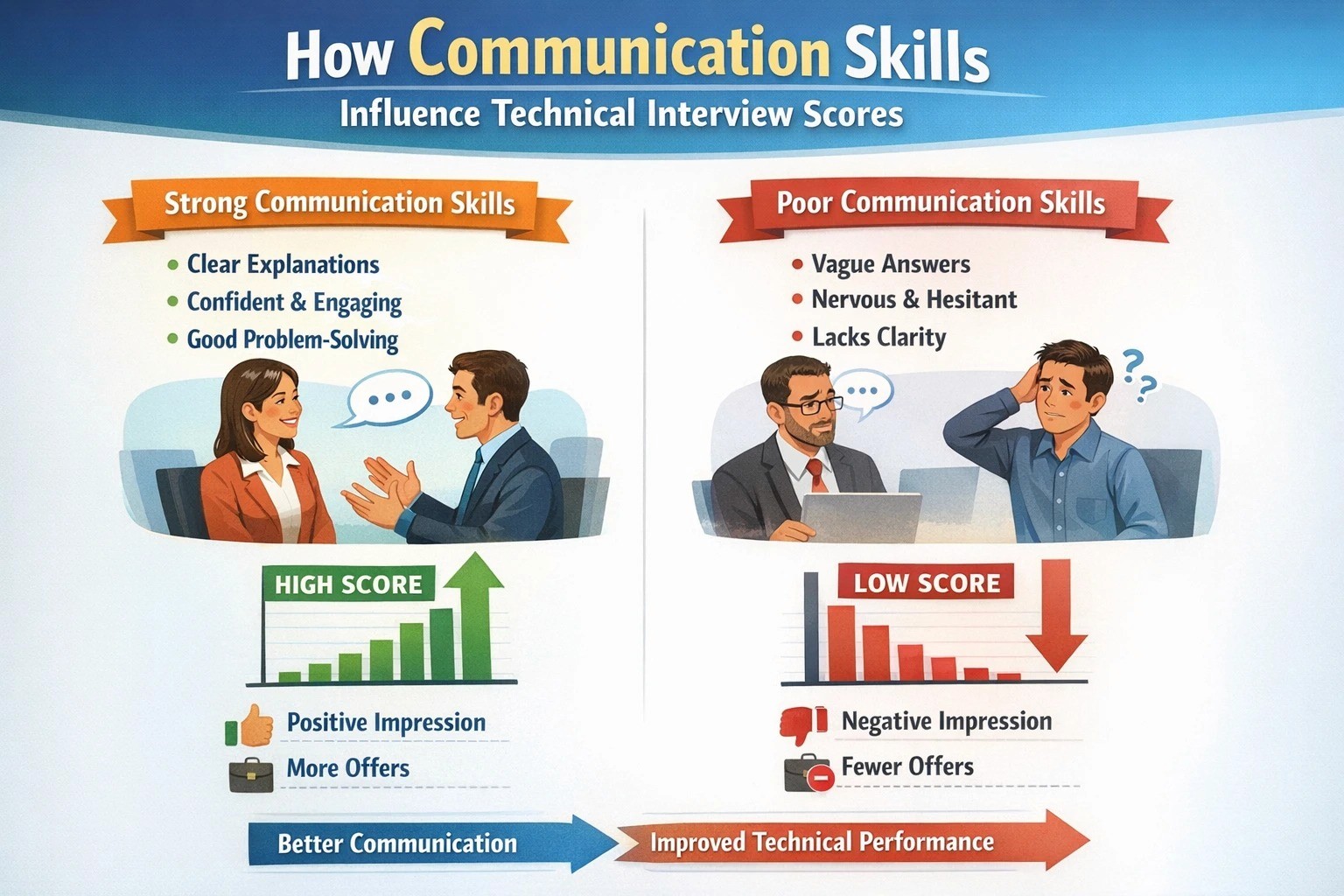
Let’s be honest, technical interviews are not exams where only the final answer matters. If you don’t speak your mind, interviewers cannot give you marks—even if you know the solution.
Many freshers lose scores not because they lack knowledge, but because they stay silent, mumble, or jump straight to code. From the interviewer’s side, silence looks like confusion. Vague answers look like memorisation. And both reduce your score.
Interviewers are not testing whether you can write code quietly. They are testing whether you understand what you are doing. If your explanation is unclear, the interviewer assumes your understanding is weak. That assumption directly affects scoring.
When you explain your approach clearly, interviewers often guide you, correct you early, or give partial credit. When you don’t explain, they let you fail silently. This is why two candidates with the same knowledge can receive very different scores.
Another hard truth: in real IT jobs, you are expected to explain bugs, design choices, and trade-offs. If you can’t communicate during an interview, interviewers doubt how you’ll perform at work. That doubt costs you marks.

Technical skill without communication is invisible. And invisible skills don’t get scored.
Checklist: What to Say During Technical Interviews
Use this as a mental script. You don’t need fancy language—just clarity.
1. When the question is asked
Say:
“Let me first understand the problem.”
“I’ll restate the problem in my own words.”
Why it matters: shows listening and clarity.
2. Before jumping to a solution
Say:
“I’ll explain my approach before coding.”
“Here’s how I’m thinking about this.”
Why it matters: makes your thinking visible.
3. While solving
Say:
“I’m breaking this into steps.”
“This part handles the main logic.”
“This condition covers an edge case.”
Why it matters: earns partial marks even if you get stuck.
4. If you’re unsure
Say:
“I’m not fully sure here, but this is how I’d approach it.”
“Can I clarify one assumption?”
Why it matters: honesty is safer than guessing.
5. If you make a mistake
Say:
“I see an issue here—this won’t work because…”
“I’ll correct this part.”
Why it matters: shows problem-solving ability.
6. After completing the solution
Say:
“I’ll quickly walk through the solution.”
“This works for these cases.”
Why it matters: confirms understanding.
7. If you don’t know the answer
Say:
“I know the basics, but not the implementation.”
“I have never worked on this yet, but I’d learn…”
Why it matters: protects your credibility.
Final Reality Check
Interviewers don’t score what you know. They score what they can see.
If you don’t explain your thinking, you reduce your own technical score—no matter how good you are.