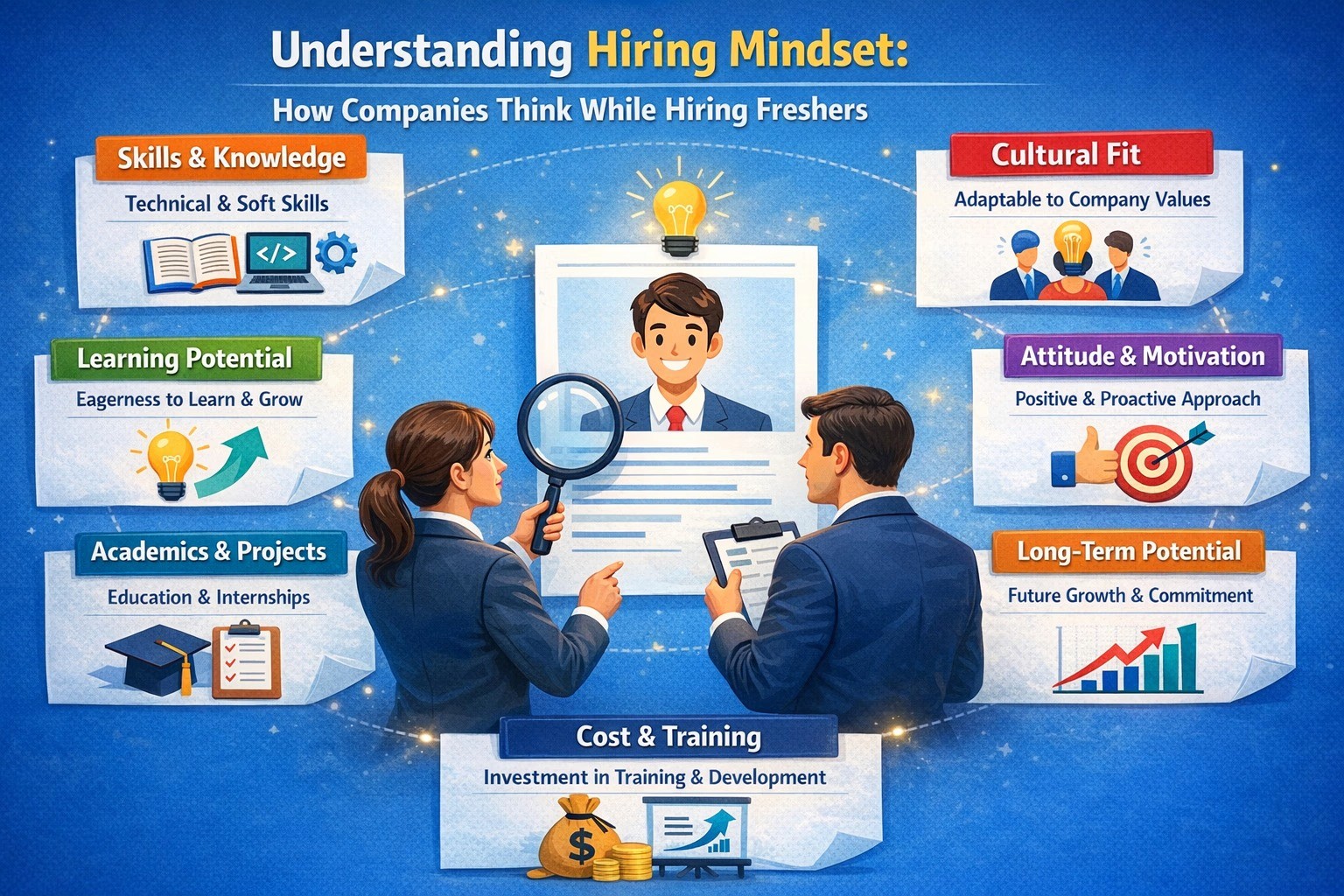
Understanding the Hiring Mindset: How Companies Actually Think When Hiring Freshers
Introduction
Many freshers walk out of interviews thinking, “I answered most questions correctly—why didn’t I get selected?”
The missing piece is often not skill, but understanding how companies think while hiring freshers.
Hiring is not an exam. It is a risk-assessment process. Once you understand this mindset, interviews start making much more sense.
1. Hiring freshers is about risk, not potential.
Companies already assume freshers lack real-world experience and will need training. They are not trying to find “hidden talent” or reward effort. Their primary concern is whether hiring you will slow the team down or fit smoothly into existing workflows.

2. Interviews are not exams; they are risk evaluations.
Getting answers right is helpful, but it is not the deciding factor. Interviewers are constantly assessing how you behave under pressure, how you respond to confusion, and whether you can be trusted to handle tasks without constant supervision.
3. Panic is a bigger problem than not knowing the answer.
Freshers often fail not because they don’t know something, but because they freeze, rush, or guess when unsure. Interviewers prefer a calm candidate who reasons step by step over someone who gives a fast but shaky answer.
4. Learning ability matters more than past exposure.
Companies know freshers haven’t used many tools. What they watch closely is how you handle hints, whether you improve during the discussion, and if you repeat the same mistakes. These signals show whether you can learn without being spoon-fed.
5. Poor explanation is seen as poor understanding.
If you cannot explain a concept clearly, interviewers assume your understanding is weak. This has nothing to do with fluent English. It is about clarity of thought and structured communication.
6. Bluffing increases risk instantly.
Trying to impress by pretending to know everything is a major rejection trigger. Candidates who openly admit gaps and explain how they would approach learning are trusted more than those who overclaim.
7. Similar skills do not lead to equal outcomes.
When two freshers have comparable knowledge, the offer usually goes to the one who stays composed, communicates clearly, and handles uncertainty professionally. From a company’s perspective, that candidate feels safer to onboard.
8. Unfamiliar questions are asked on purpose.
Real IT work involves unclear requirements, new tools, and incomplete information. Interviewers use unfamiliar questions to see whether you think logically or shut down when things are not obvious.
9. Companies want to feel safe before making an offer.
By the end of the interview, hiring teams are silently checking whether you understand basics, learn from feedback, communicate well, and won’t become a daily support burden.
10. The hard truth freshers must accept.
Companies do not hire freshers to prove brilliance. They hire freshers to build reliable professionals. If you prepare only to impress, you fail. If you prepare to show clarity, honesty, and learning ability, you improve your chances significantly.
Final reality check.
Companies don’t hire freshers to become instant experts.
They hire freshers to build future professionals.
If you understand that hiring is about trust, learning ability, and low risk—not perfection—you can prepare smarter and perform better.
Join WhatsApp Groups for Updates
Group 1: CLICK HERE> https://chat.whatsapp.com/KAXuSLpag96DcdMDsphFrO
📢 Don’t forget to forward this message to your friends and help them kick-start their careers