Why Does Everyone Say ‘Practice More’ but Not Tell What to Practice?
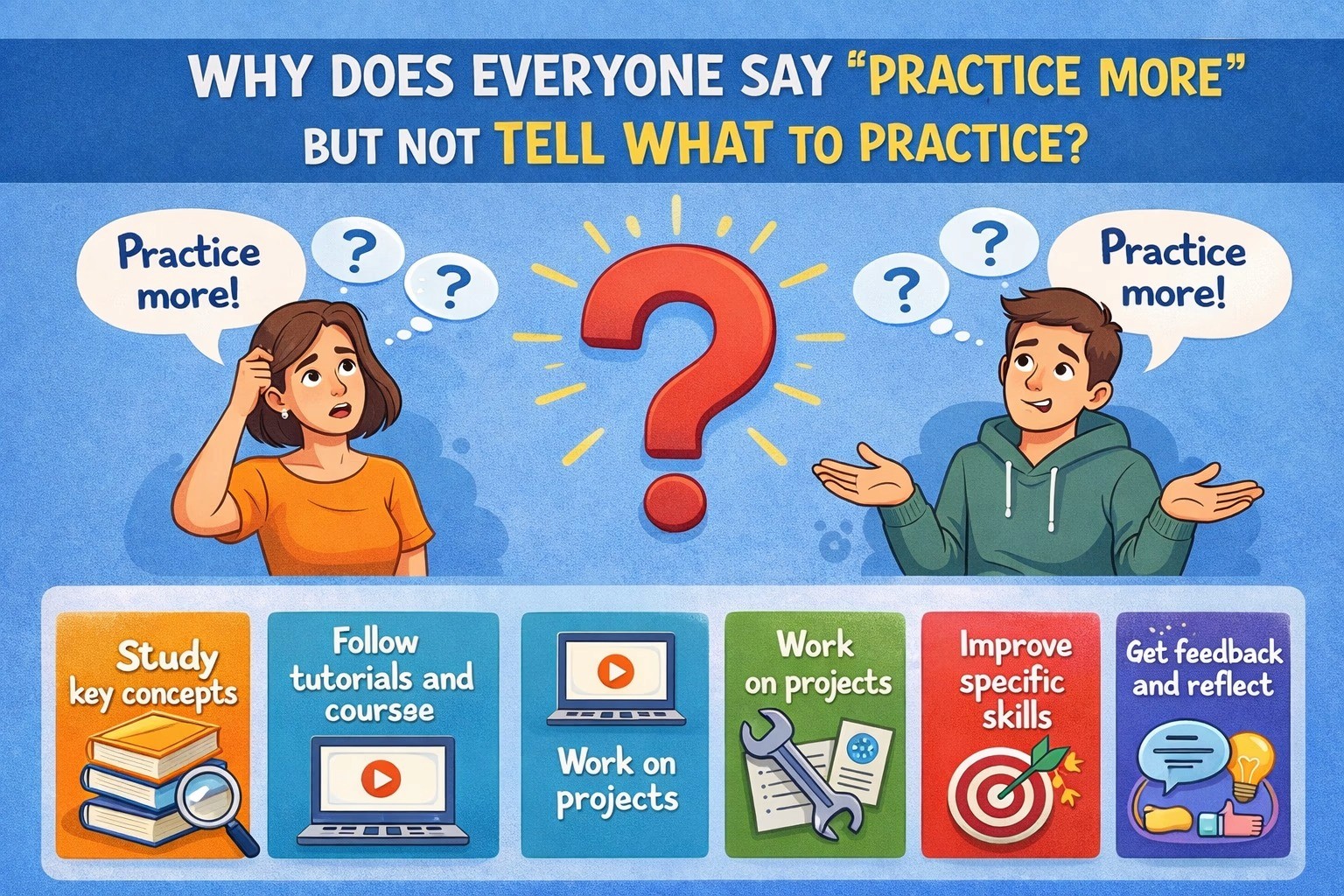
Almost every fresher hears this advice after a rejection:
“Just practice more.”
It sounds simple—but also frustrating.
Practice what exactly? Coding? Aptitude? Projects? Interviews?
The problem isn’t that the advice is wrong.
The problem is that it’s incomplete.
Let’s clarify what “practice” actually means in the context of IT interviews and assessments.
“Practice More” Is a Shortcut for Several Skills
When interviewers or seniors say “practice more,” they usually mean you need improvement in one or more specific areas, but they don’t spell it out.

In fresher hiring, practice usually refers to:
applying concepts without guidance
thinking step by step under pressure
explaining your approach clearly
handling unfamiliar questions calmly
Simply solving more questions is often not enough.
Practicing Only What Feels Comfortable Doesn’t Help
Many freshers practise what feels safe:
watching more tutorials
repeating similar MCQs
re-solving known problems
This creates familiarity, not readiness.
Interviews and online tests expose you to:
new problem statements
slight variations
follow-up questions
If your practice doesn’t include discomfort and uncertainty, confidence won’t improve.
What You’re Actually Expected to Practice
1. Explaining Your Thinking
Most rejections happen not because the answer was wrong, but because the reasoning was invisible.
Practice:
saying your approach out loud
explaining why you chose a step
summarising your solution at the end
If you can’t explain it, interviewers can’t score it.
2. Solving Without Looking at Solutions
Real practice means:
reading a question
attempting it fully on your own
getting stuck
fixing mistakes
Using solutions too early turns practice into passive learning.
3. Handling “I Don’t Know” Moments
Interviews always include unfamiliar questions.
You should practise:
restating the problem
making assumptions
explaining how you’d approach it
saying what you’d check or learn next
This is a skill, not a personality trait.
4. Turning Projects into Interview Proof
Many freshers have projects but haven’t practised talking about them.
Practice explaining:
what problem the project solved
your specific role
what went wrong
how you fixed it
This matters more than adding new projects.
5. Accuracy Over Speed
Online assessments punish careless speed.
Practice:
reading questions carefully
checking conditions
avoiding assumptions
One logical mistake can cost more than solving fewer questions correctly.
A Simple Way to Understand “Practice More”
When someone tells you to “practice more,” think of it this way:
They're asking you to work on how you think through problems, explain your approach, and deal with unknown situations—not just attempt a higher number of questions.
The Real Reason People Don’t Explain This
People who say “practice more” have usually developed these skills gradually without realizing it. They often overlook the fact that freshers need clear guidance, not vague or general advice.
Final Takeaway
Practice is not about quantity.
It’s about the right kind of repetition.
If your practice includes:
thinking aloud
solving without hints
explaining your work
staying calm when unsure
then you’re practising the right things—even if you practise less.
That’s what interviewers actually mean.
Join WhatsApp Groups for Updates
Group 1: CLICK HERE> https://chat.whatsapp.com/KAXuSLpag96DcdMDsphFrO
📢 Don’t forget to forward this message to your friends and help them kick-start their careers